
Run a Saline County Registry Check
The Illinois State Police maintains the statewide public registry and says it updates the data each day. A Saline County search can start with a first and last name, then add a birth date or place filter to narrow possible matches. A county-wide view uses Saline in the county dropdown. An address question calls for the Map Your Neighborhood tool. No separate county list was located in the official research, so the ISP system is the main public search.
Save the search terms and date used when accuracy matters. The live registry may change after a local verification or correction.
Prepare known spellings, aliases, date of birth, city, and ZIP before searching. A result should be matched by more than a name or photograph. Physical descriptors, address status, offense information, and the last verification date help distinguish people with similar names. The local registering agency handles accuracy questions. The conviction county's Circuit Clerk or State's Attorney holds the court material behind the public offense summary.
Saline County Registration Contact
The Saline County Sheriff's Office is the local registration and accuracy contact for people who live in sheriff jurisdiction. It is at 1 N. Main Street in Harrisburg and answers at 618-252-8661. City residents may register with the police chief as Illinois law directs. Call first for an appointment and current processing hours. A dispatch line that operates all day does not mean registry paperwork is handled at every hour.
ISP directs questions about the accuracy of a listing to the registering law-enforcement agency. Report suspected noncompliance to police rather than confronting anyone. If the profile points to a conviction elsewhere, request the underlying judgment from that county's clerk. Those distinct channels keep a profile correction, a compliance report, and a court-copy request with the office that can act on it.
Search the Illinois Sex Offender Registry
The Illinois Sex Offender Registry opens with conditions of use. Accept them, choose a search route, and narrow only with facts that are known. Broad place searches can reveal nearby public listings, while exact-name searches work best when paired with a birth date. Filters describe what the system publishes; they do not prove that every similar name is the same person.
- Open the ISP registry and accept its use conditions.
- Enter a name or select Saline County, city, ZIP, status, or map route.
- Compare the result list with several known identifiers.
- Open the profile and read its status, offense, agency, and verification fields.
| Field Label | Type | Required | Notes |
|---|---|---|---|
| First Name / Last Name | Text | No | ISP recommends starting with both names. |
| Date Of Birth | Date or text | No | Use only when reliably known. |
| City / Zip Code | Text | No | Municipality spelling and five-digit ZIP matter. |
| County, Incarcerated or Out of State | Select | No | Select Saline for a county view. |
| Status / Homeless / Offender Type | Select or checkbox | No | Narrows category and compliance results. |
| Map Your Neighborhood | Map link | No | Provides an address and geographic search. |
Compare Saline County Search Routes
Name and map searches answer different questions. Begin with first and last name when checking a known person, since ISP recommends that route before adding filters. Date of birth can reduce false matches. Use city, ZIP, or Saline County when the question concerns a place rather than one known identity. The Homeless, Status, and Offender Type controls can refine a result set, but each label must be read in the context of the live profile.
The neighborhood map supports local awareness, not a guarantee that no registrant is present beyond its markers. Records may change as an address or compliance status is verified. ISP updates the registry daily, while the registering agency supplies or corrects local information. When a result appears stale, note the registry identifier and displayed agency before calling. Do not circulate an accusation based on a map pin.
The ISP sex offender information hub is shown in the official project capture.
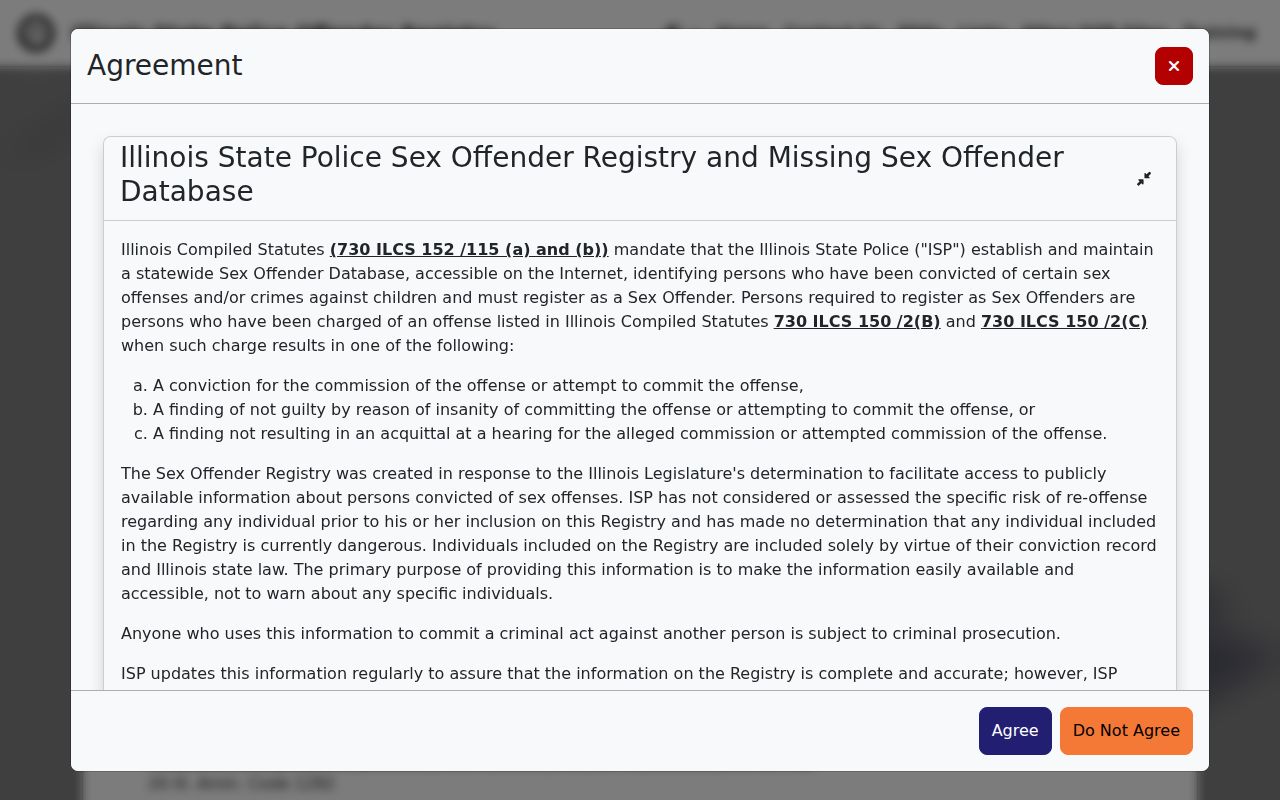
That hub provides the state context for the search, registration rules, and official guidance.
What Saline County Profiles Show
A public profile combines identity clues with registration facts. It may show names and aliases, a photograph, physical traits, date of birth or age, address information, the registering agency, county, compliance status, and a verification date. It can also list an offense description, statute, conviction place and date, and limited victim-category facts when the law permits. It is not a full police narrative or a copy of the judgment.
| Name & Aliases | Published identity names and a registry or SID-style identifier where public. |
|---|---|
| Photo & Description | Photograph, age or birth date, sex, race, height, weight, hair, eyes, scars, marks, or tattoos. |
| Registered Address | Current public address or status information and registering agency. |
| Offense & Statute | Description, citation, conviction or adjudication date, and place when displayed. |
| Classification | Illinois category shown by ISP, not an invented federal tier. |
| Registration Status | Compliance state and latest verification or update data. |
Saline County Profile or Judgment
A registry offense line is a notification summary. It should not be stretched into facts the profile does not state. The filed case may contain amended charges, pleas, findings, and the sentencing order. For a Saline County conviction, the Circuit Clerk at 10 E. Poplar Street in Harrisburg is the official court-file custodian. Registry accuracy questions instead go to the local registering agency.
This split also explains why two official records can look different. The profile serves present registration and notice duties. The court file preserves the case history. A person may need both to understand the listed offense and the current registry status, but one should never be treated as a substitute for the other.
The official registry search and profile interface appears in a second successful project capture.
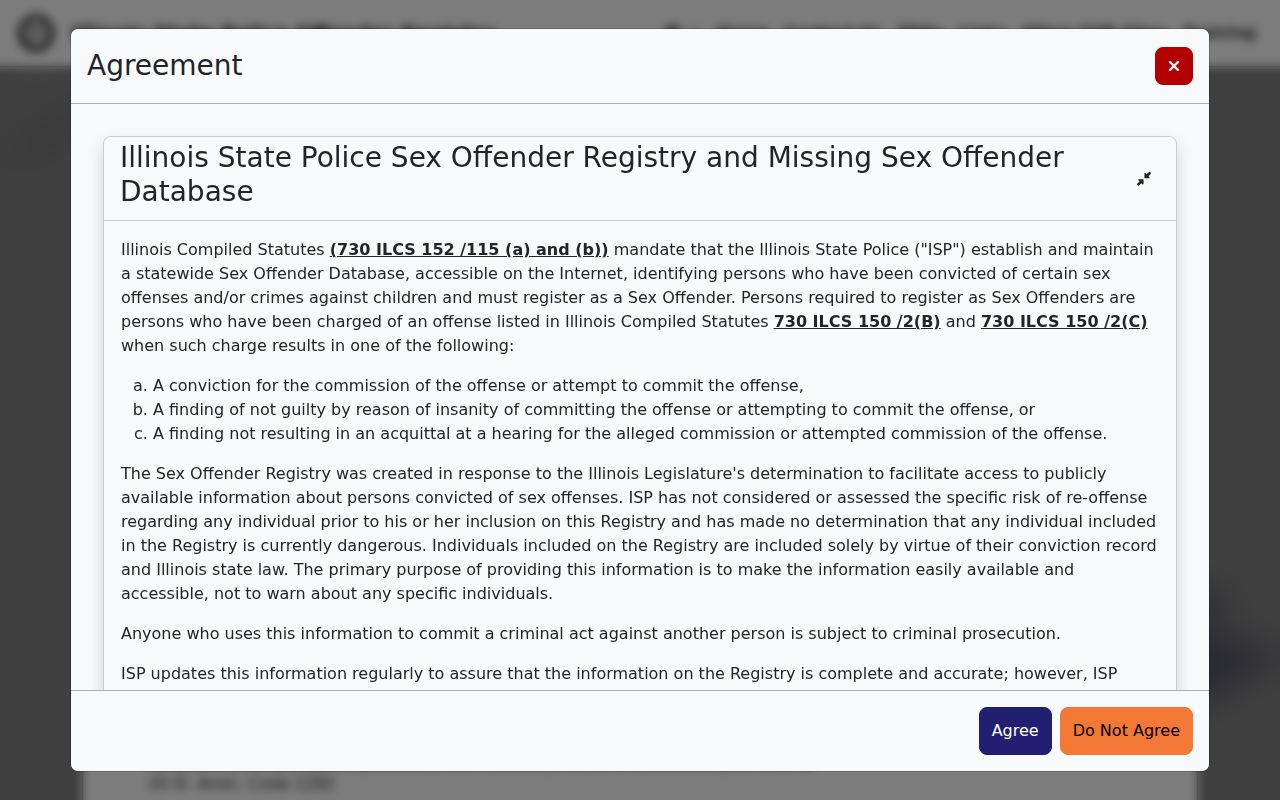
Its search and detail screens show why filters and profile fields must be read together.
Illinois Registration Terms and Categories
Illinois uses statutory categories such as sex offender and sexual predator, not a simple public Tier I, II, and III chart. Under 730 ILCS 150/7, many ordinary-term registrants have a ten-year duty under the statute's calculation. Sexual predators and other listed categories register for natural life. Interruptions, extensions, and special status rules can change the practical end date, so rely on the current ISP classification and the Act.
| Level / Tier | Duration | Verification Frequency |
|---|---|---|
| Ordinary-term sex offender | Generally ten years under the statutory calculation | Generally annual in-person verification |
| Sexual predator | Natural life | Annual, subject to current statutory duties |
| Sexually dangerous or violent person and other lifetime categories | Natural life under specified provisions | May be every 90 days for specified categories |
| Noncompliant, homeless, or transient status | Depends on classification | Special or more frequent reporting may apply |
Saline County Verification Changes
ISP's published guidance says initial and annual registration fees are $100. Address, status, and other reportable changes generally must be reported within three days. Verification may be annual or every 90 days based on the statutory category and status. Those rules concern the registrant's duty; a public user should report a suspected issue to law enforcement and let the agency investigate.
Residency and presence limits also depend on the classification, current law, and facts. A broad claim that one distance rule applies to all listed people is unsafe. Read the profile, consult the current statute, and ask the registering agency about a genuine compliance concern. The sheriff's local role is to register and verify within its jurisdiction, not to provide legal conclusions about every address.
Verification dates deserve close attention. A date shows when the listed agency last performed the recorded check; it does not predict where a person will be at every moment. Homeless or transient status can carry special reporting duties, while incarcerated or out-of-state entries use their own registry labels. Read those labels as status facts supplied by the official system. If a listed person cannot be located and there is a sound reason to believe registration is required, ISP directs the public to contact local law enforcement. Give police the profile identifier and facts without attempting a personal investigation.
Cross-State Saline County Searches
The Illinois registry is the first source for an Illinois address. When a search crosses state lines, the U.S. Department of Justice's National Sex Offender Public Website offers a broader layer. NSOPW queries participating public registries, but the originating state profile remains the place to read its classification and local contact information.
The official National Sex Offender Public Website is included in the project images.
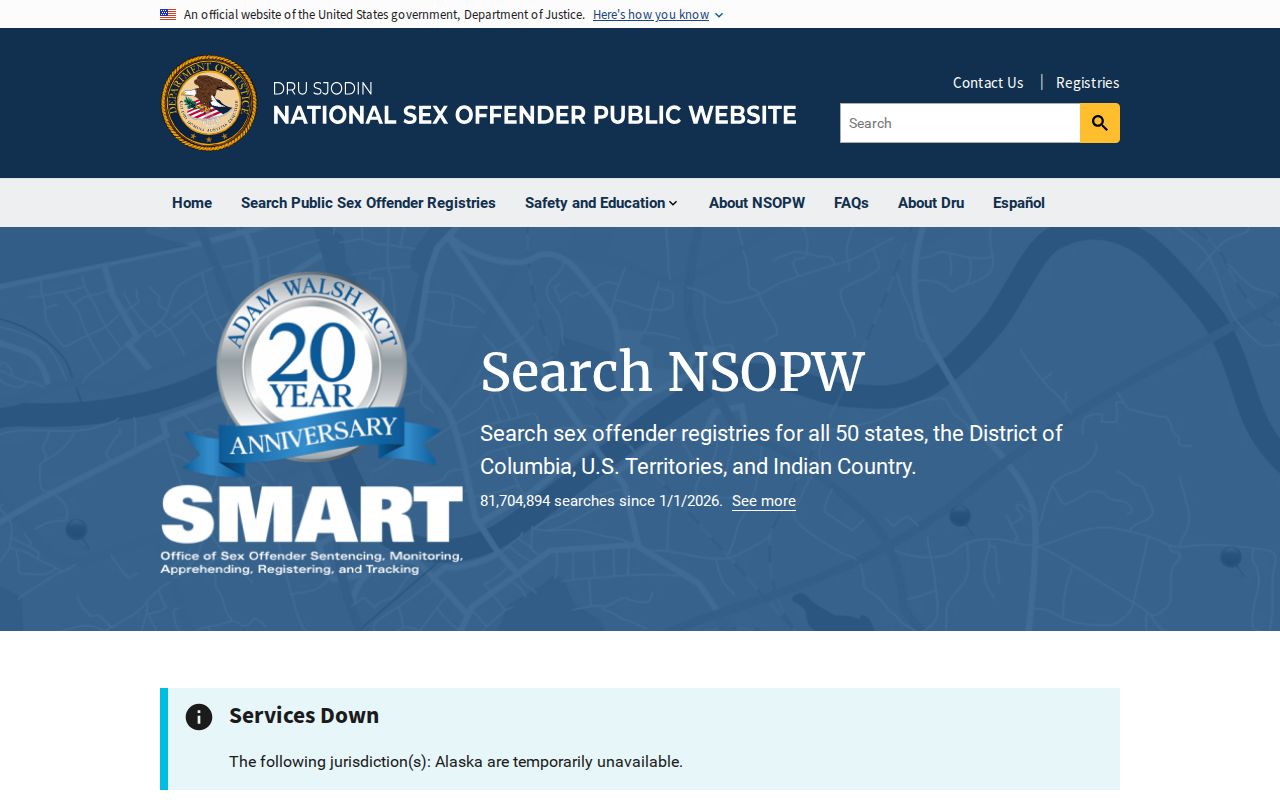
Use this national layer to widen geographic coverage, then verify the details in the relevant state registry.
Lawful Saline County Registry Use
The registry exists for public awareness and safety planning under the Illinois Sex Offender Community Notification Law, 730 ILCS 152. Use verified details to make calm, lawful choices and send suspected noncompliance to police. Never confront, follow, expose, or threaten a listed person or household. A public listing is not permission for trespass or vigilantism.
Misuse warning: Threats, stalking, harassment, trespass, intimidation, or vigilantism based on registry information can be crimes under Illinois law. Report concerns to law enforcement.